Wednesday, June 26, 2013

GINGER BEER

Last week we made ginger beer, using a recipe that we found on Suzy's world website. Follow this link for more information and the recipe.  suzys world

SO ...
today we were finally able to have a taste.


As you can see we had rather an exciting reaction!

When we were making the mixture for ginger beer, we had lots of conversations about how substances can change.

Two easy changes for us to see were: the sugar, which melted or dissolved.
and the yeast used the sugar to create energy, releasing carbon dioxide, which is what makes the fizz!


Wednesday, May 15, 2013


JUICY POTIONS


Definition of a 'Potion':
 A liquid that is believed to have a magical effect on someone who drinks it:


Today we made 'juice' potions and while we don't think they had any magical effects on us we know that they were good for us. Fruit juices taste good, are nutritious and can be beneficial for our health because they are rich in vitamins, minerals.

Aaron brought in some 'super juice' for us all to try, then we got to make out own.
We had carrots, apples, oranges, and ginger to run through the juicers. It was amazing to see how many carrots you needed to make only 1/2 a cup of juice!  This is one of the reasons why it is important to only drink straight fruit juice in moderation.  Not many of us could eat 12 big carrots in a go, but it would be easy to drink the 1/2 a cup of juice they produce!

 Then we go on the business and mixed a couple together to see how they tasted.

Potion number 1: Carrot and Apple juice.
Potion number 2: Orange, Apple and Ginger juice.

Number two was a definite winner with us all.  Next week we are going to have a go with a few vegetable combinations!


Tuesday, April 16, 2013

LIP BALM


There won't be any chapped lips for herbs and potion students this winter. Today we finally got to make our lip balm.
We used a recipe that we found on the Martha Stewart Website which was very easy to follow.  The website even has a short video clip that we were able to watch to make sure we were on the right track!

Martha Stewart-scented-lip-balm

1 tablespoon beeswax pearls (also called pellets or pastilles)
1 tablespoon pure shea butter
2 tablespoons sweet almond oil


To make tinted balm, add small amount of coloured lipstick to your melted mix.

Melt beeswax, shea butter, and almond oil together in the top of a double boiler or in a heat-safe bowl set over a pot of simmering water; stir continuously with a whisk. Once the ingredients are liquefied, remove them from heat.  to a measuring cup or a container with a pour spout and then divide it among 10 5 ml lip balm containers. Let balms cool completely until solid, about 20 minutes. 
You can also add 6-10 drops of essential oils to this mix.  You need to do this when the wax and Shea butter are totally melted.  THEN Whisk them in quickly.
We found the best way to transfer the balm into the containers was using a dropper.  This meant we didn't spill it too much!

Tuesday, March 26, 2013

Today we spent some time looking at how to make bath bombs, lip balm and candles.
We also have a great website, that was recommended to us, where we can buy some of the ingredients that we are going to need.

Go Native

Lip Balm Recipe

Bath Bombs

Balloon Candles

Hopefully we will get some ingredients ordered and be able to make a couple of these next week.

Monday, March 18, 2013

Herbs and potions on a Friday

We had run out of time on Wednesday (and Mrs Hanlon cracked the egg yolk) so some of us decided that we would make the lavender breath fresheners on Discovery Day.

We followed the recipe and left them to set over the weekend.  They didn't look quite like the pictures on the internet but they were certainly edible.

Some of us are not too sure about the taste - the lavender oil was very strong, and the bits of lavender aren't that nice.  A couple of us want to have a go again at home, adding some honey and changing the lavender oil and flowers for mint.

Mrs Hanlon is looking forward to hearing how these experiments go.

Click here to make your own breath fresheners

Wednesday, March 13, 2013

Wednesday 13th March

Today was a taste sensation.

Mrs Hanlon raided the herb garden and brought in a variety of different herbs that we were able to taste and smell.

We tasted Lemon Verbena, Apple Mint, Pineapple Sage, Rosemary, Sage, Stevia, Fennel, Lavender, Comfrey, Fenugreek, Cumin, Cardamon, and Liquorice Root.

Our next project today was to plant the herbs that Mrs Hanlon had brought.  We used Meredyth's Gumboot planter and got this all set up.  Hopefully we remember to water them and they will be there for others in the school to enjoy.

We also discussed how the drought is effecting the plants at the moment, and how this might make it hard for us to be able to find herbs to press for our herbals and our other options.
While we had also planned to make some Lavender Breath Fresheners, we ran out of time (and Mrs Hanlon broke the egg yolk into the white) so we are planning to have a go at making these on discovery Friday.

Another question that came up today was what is the difference between herbs and spices.
The words herb and spice are often used interchangeable.  Both are obtained from plants and primarily used for adding flavour and aroma to food.  While there are similarities, there are also some subtle differences between herbs and spices

Herbs come from the leave of herbaceous (Non-woody) plants.  
Spices come from roots, flowers, fruits, seeds or bark.
Some plants are both herbs and spices.  For example Coriander (cilantro) leaves are a herb, but the seeds from the plant are a spice.


Wednesday, March 6, 2013

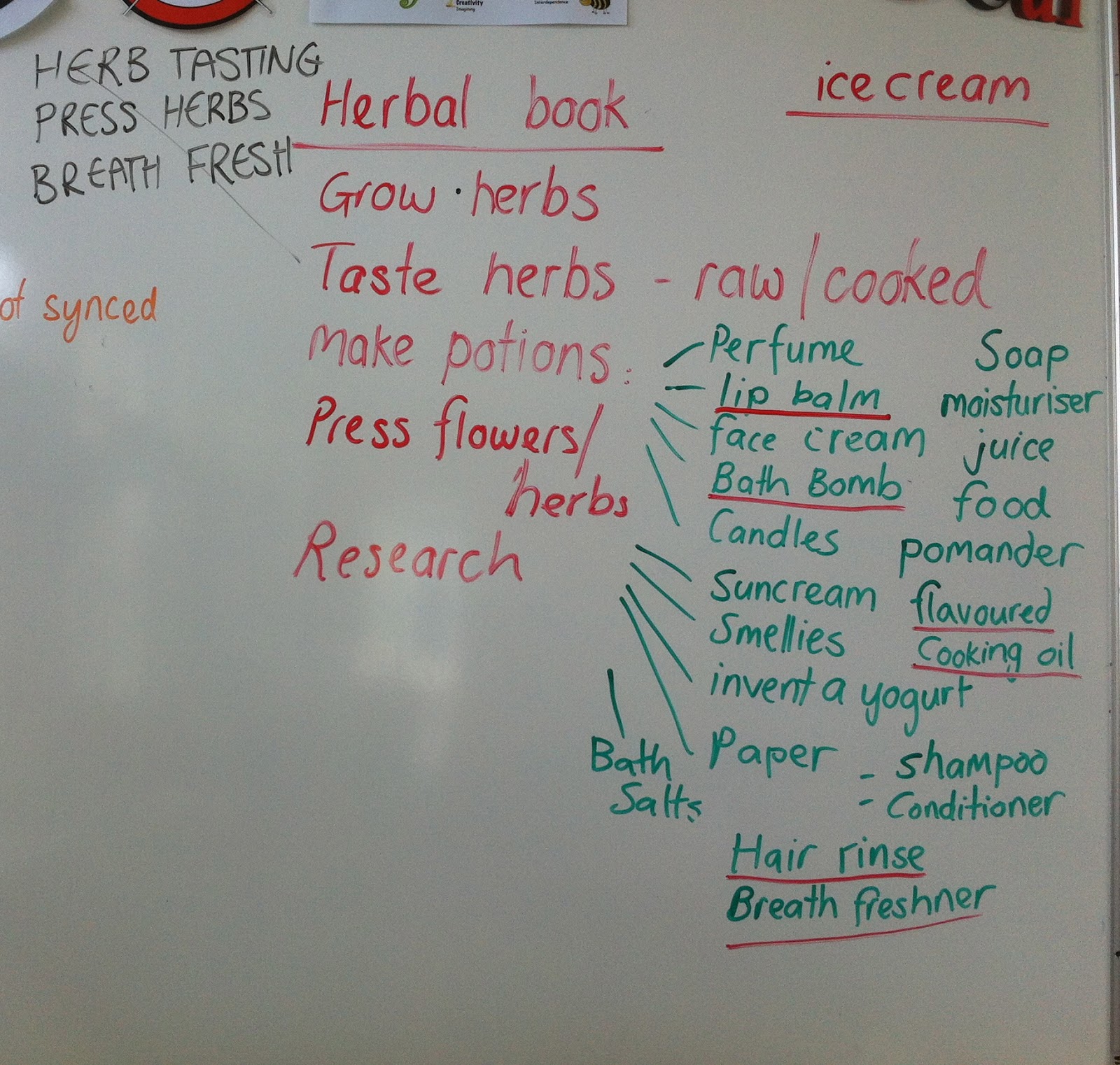
Today was our first herbs and potions session - no we can't quite make polyjuice like Harry Potter, and no we haven't got the cauldron bubbling.  But we do have a keen interest in making items using herbs and plants that we find in the gardens around us.

There was lots of talking and ideas shared today, sharing our knowledge and making plans for the next few weeks.

Mrs Hanlon brought in a herbal that she made when she was in year 6 (many, many years ago) we worked out her book must be nearly 30 years old!

A herbal is a book that has the names and descriptions of plants.  It contains information about the plants properties, in particular how they might help your health, how to use them in cooking.   Often there are legends and magical powers associated with the plants too.

Most of us would like to make one of these over the next few weeks as well as experimenting in making some of the ideas that we brainstormed together